

Ever wonder why tech giants suddenly care about Australia? While everyone's focused on Silicon Valley drama, OpenAI just quietly announced a $4.6 billion move that's about to reshape the entire Asia-Pacific tech landscape. And here's what the business headlines aren't telling you.
The $4.6 Billion Deal Everyone's Talking About
OpenAI didn't just decide to expand to Sydney on a whim. They've partnered with NextDC to build what's essentially Australia's first sovereign AI supercomputer campus. We're talking about a hyperscale AI infrastructure facility that'll make most current data centers look like pocket calculators.
The project's landing at NextDC's S7 campus in Eastern Creek, Western Sydney. But here's the kicker – this isn't just another data center. It's designed as a GPU supercluster that can handle ultra-dense AI deployments. Think of it as OpenAI's regional brain center for the entire Asia-Pacific region.

The timeline? First phase goes live in late 2027. That gives OpenAI roughly three years to build what could become the most powerful AI infrastructure outside of the United States.
Why Sydney Matters More Than You Think
Here's what business experts won't tell you: geography is everything in AI. While everyone's obsessing over which AI model is smarter, the real game is about latency – how fast AI can respond to users.
Sydney isn't just some random choice. It's perfectly positioned to serve the entire Asia-Pacific region with lightning-fast AI responses. When someone in Tokyo, Singapore, or Melbourne asks ChatGPT a question, that request won't have to travel all the way to Oregon anymore.
But there's another layer most people miss. Australia's government has something called the Security of Critical Infrastructure (SOCI) framework. This facility will be fully compliant, meaning it can serve government, defense, healthcare, and financial services without the data sovereignty headaches that plague other international AI deployments.
OpenAI's also opening their first Australian office as part of this expansion. That's not just about having local sales reps – it's about building relationships with Australian businesses that need AI solutions built specifically for local regulations and needs.
What This Means for Australian Businesses
Remember when AWS first came to Australia and suddenly every startup could access enterprise-grade infrastructure? This is bigger.
OpenAI's already working with some heavy hitters:
• Commonwealth Bank (imagine AI-powered banking that actually understands Australian regulations)
• Canva (the design unicorn that's already AI-powered is about to get supercharged)
• Atlassian (better project management tools with local AI processing)
• Virgin Australia (AI flight optimization without data leaving the country)
• Coles (supply chain AI that understands Australian consumer behavior)

But here's the part that gets me excited – the smaller players. Right now, if you're an Australian startup wanting to build AI features, you're dealing with international APIs, currency fluctuations, and data compliance nightmares. This changes everything.
I spoke with a friend who runs a small fintech company in Melbourne. She's been wanting to add AI-powered fraud detection but couldn't justify the compliance costs of sending customer data overseas. "This Sydney facility could be a game-changer," she told me. "Finally, we can compete with the big banks on AI without the regulatory minefield."
The Jobs and Economic Impact No One's Discussing
Everyone's talking about job displacement from AI, but nobody's talking about job creation from AI infrastructure. This project will create thousands of construction jobs initially, then hundreds of ongoing technical roles.
But the real story is the ecosystem effect. When you build AI infrastructure, you don't just create data center jobs – you create an entire supporting economy.
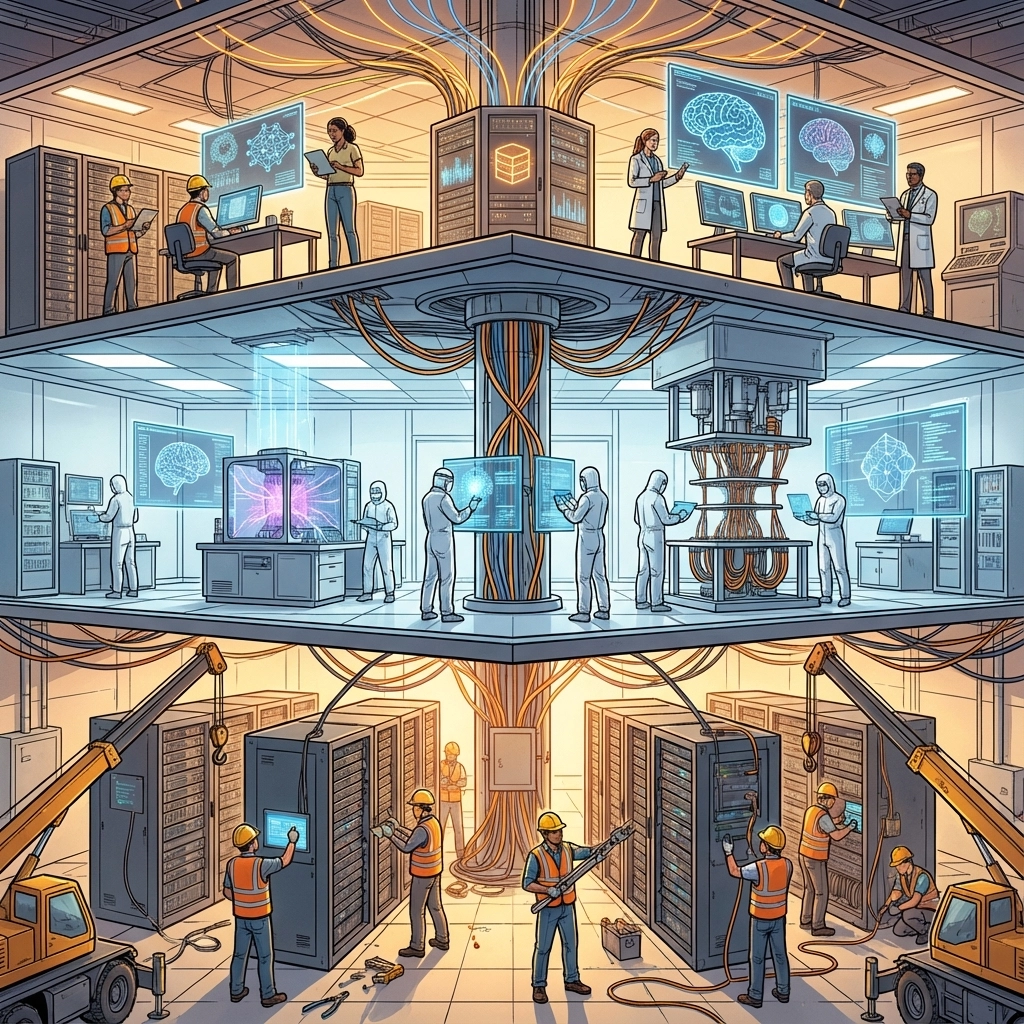
Think about it: AI researchers who don't want to move to Silicon Valley anymore. Startups that can access world-class AI without leaving Australia. Universities that can run cutting-edge research without shipping data overseas. Enterprise customers who can finally use advanced AI without compliance headaches.
The facility will run entirely on renewable energy and uses advanced cooling systems that don't require drinking water. In a country where water is precious, that's not just environmentally smart – it's politically smart.
OpenAI's also launching training programs with local universities and a founder initiative for Australian startups. They're not just building infrastructure – they're building an AI ecosystem.
What really caught my attention is the partnership approach. Instead of coming in and dominating like some tech giants, OpenAI's working with existing Australian companies. NextDC provides the infrastructure expertise, local businesses provide the market knowledge, and universities provide the talent pipeline.
The timing couldn't be better either. While other tech giants are pulling back from international expansions or dealing with regulatory backlash, OpenAI is doubling down on building local presence and partnerships.
This isn't just about serving existing customers faster – it's about enabling entirely new types of AI applications that simply weren't possible when all the processing power was on the other side of the world.
So here's my question for you: if you could access the same AI capabilities as Silicon Valley startups but with local data processing and Australian compliance, what would you build?