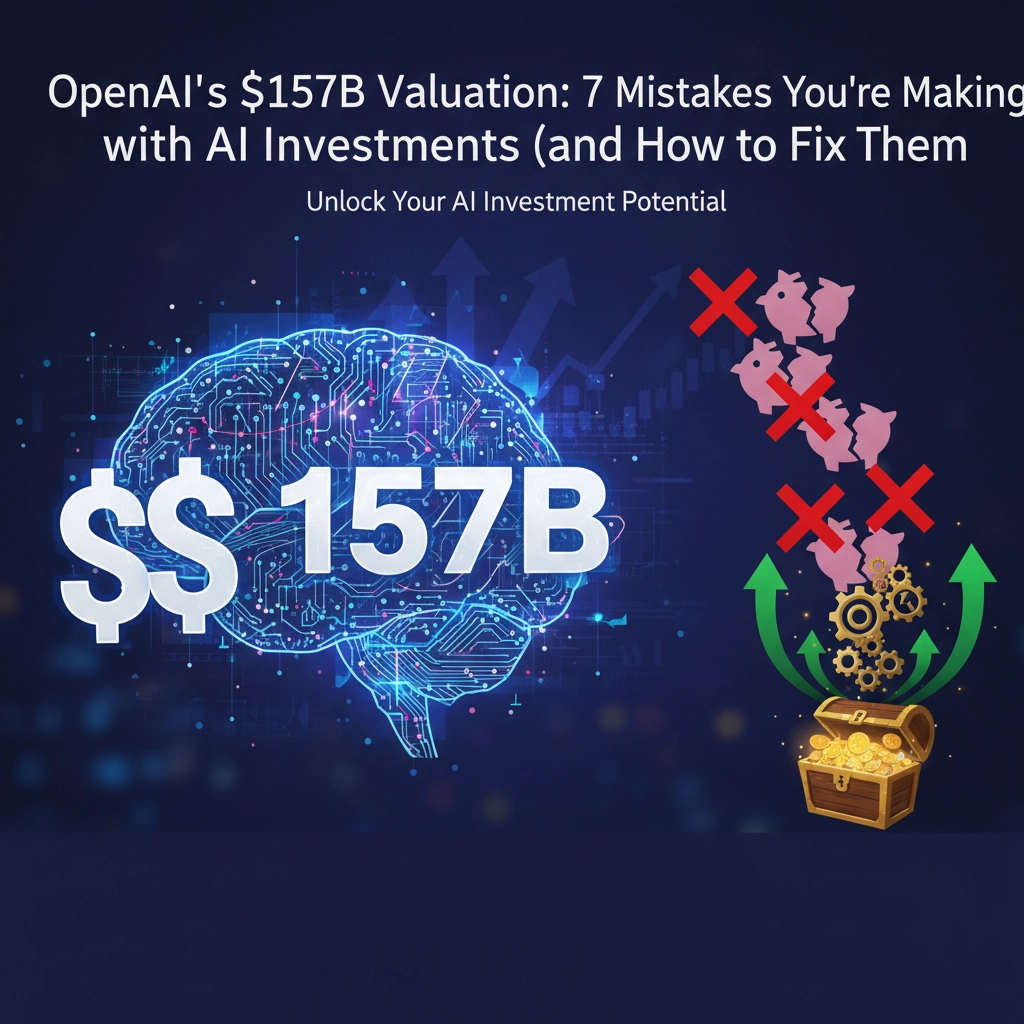
Did you know OpenAI's $157 billion valuation makes it worth more than 85% of S&P 500 companies? Yet most investors are making critical mistakes when it comes to AI investments that could cost them big time.
Here's the thing: when ChatGPT's parent company raised $6.6 billion in October 2024, it wasn't just another tech funding round. It was a wake-up call for anyone thinking about AI investments. The company that was valued at $29 billion just two years ago is now worth more than Goldman Sachs.
But before you start throwing money at every AI stock or startup, let's talk about the seven massive mistakes I'm seeing everywhere: and how to avoid them.

The Valuation Reality Check: What OpenAI's Numbers Really Mean
OpenAI's $157 billion valuation isn't just a number: it's a mirror reflecting how most people misunderstand AI investments. The company is burning through cash faster than a Formula 1 car burns rubber, spending billions on computing power and talent.
Yet investors keep piling in. Why? Because they're making mistake number one.
Mistake #1: Chasing Headlines Instead of Fundamentals
Everyone sees "OpenAI valued at $157B" and thinks they need to get in on AI immediately. But they're not looking at the actual business model. OpenAI is spending $7 billion annually just on computing costs. That's like running a small country's budget.
Fix: Before investing in any AI company, ask yourself: How do they actually make money? What's their path to profitability? OpenAI's revenue is growing, but so are their costs.
Mistake #2: Ignoring the Infrastructure Reality
Here's something most people don't realize: OpenAI doesn't own the chips that power ChatGPT. They rent them from cloud providers like Microsoft. It's like opening a restaurant but renting all your kitchen equipment at premium prices.
Smart investors are looking at the companies that actually own the AI infrastructure: the chip makers, the data centers, the cloud providers.
Fix: Consider investing in the picks and shovels of the AI gold rush. Think NVIDIA, AMD, or cloud infrastructure companies rather than just the end-user applications.
The Diversification Trap and Timing Disasters
Mistake #3: Putting All Eggs in the OpenAI Basket
I met a guy last month who sold his entire stock portfolio to buy into AI companies. His reasoning? "OpenAI is worth $157 billion, so AI is the future." He's not wrong about AI being huge, but he's making a classic rookie error.
The AI space is moving so fast that today's leader could be tomorrow's MySpace. Remember when everyone thought Google+ would kill Facebook?
Fix: Treat AI investments like any other sector. Diversify across different AI applications, company sizes, and even geographic regions. Don't bet your retirement on one technology trend.
Mistake #4: Terrible Market Timing
OpenAI's valuation jumped from $80 billion to $157 billion in just months. Seeing this, many investors think they're "late to the party" and make panic decisions: either jumping in at peak valuations or avoiding AI entirely.
Fix: Dollar-cost averaging works for AI investments too. Instead of trying to time the perfect entry point, consider making smaller, regular investments over time.

The Regulation Blind Spot and Competition Myopia
Mistake #5: Completely Ignoring Regulatory Risks
OpenAI's success has caught the attention of regulators worldwide. The EU is already implementing AI regulations, and the US isn't far behind. Yet most AI investors act like regulation doesn't exist.
Think about what happened to social media companies when privacy regulations hit. The same could happen to AI companies that don't prepare for regulatory changes.
Fix: Research the regulatory landscape before investing. Look for companies that are already building compliance into their business models rather than hoping regulations won't affect them.
Mistake #6: Underestimating the Competition
Everyone's obsessed with OpenAI, but Google, Amazon, Microsoft, and dozens of startups are all building competing AI systems. The competitive moat in AI isn't as wide as people think.
Google's Gemini is getting better fast. Anthropic (backed by Google and Amazon) is making serious moves. Even smaller companies like Perplexity are finding their niches.
Fix: Don't invest based on current market leaders alone. Look for companies with sustainable competitive advantages: unique data, better business models, or superior distribution channels.
The Biggest Mistake of All
Mistake #7: Not Understanding What You're Actually Buying
This is the big one. Most people investing in AI don't actually understand what they're buying. They see big valuations and assume it's all upside.
When you invest in OpenAI (or any AI company), you're betting on:
- Their ability to keep improving their technology
- Finding sustainable revenue models
- Competing against tech giants with infinite resources
- Navigating regulatory challenges
- Maintaining their talent pool (AI engineers are expensive)
Many AI companies are still figuring out basic questions like "How do we make money?" and "What happens when our compute costs keep growing?"
Fix: Only invest in what you understand. If you can't explain how an AI company makes money to a 12-year-old, you probably shouldn't invest in it yet.

The Smart Way Forward
Here's what successful AI investors are actually doing instead of chasing valuations:
- Building diverse portfolios that include AI infrastructure, applications, and adjacent technologies
- Focusing on companies with clear revenue models rather than just impressive demos
- Considering the entire AI ecosystem, not just the headline-grabbing companies
- Staying informed about regulatory changes and their potential impacts
- Taking a long-term view rather than trying to flip AI investments quickly
The AI revolution is real, and there's money to be made. But the biggest opportunities might not be where everyone's looking right now.
OpenAI's $157 billion valuation is impressive, but it's just one data point in a massive, evolving market. The real question isn't whether you should invest in AI: it's whether you're smart enough to avoid the mistakes that are costing other investors big time.
What's your biggest concern about investing in AI companies right now?