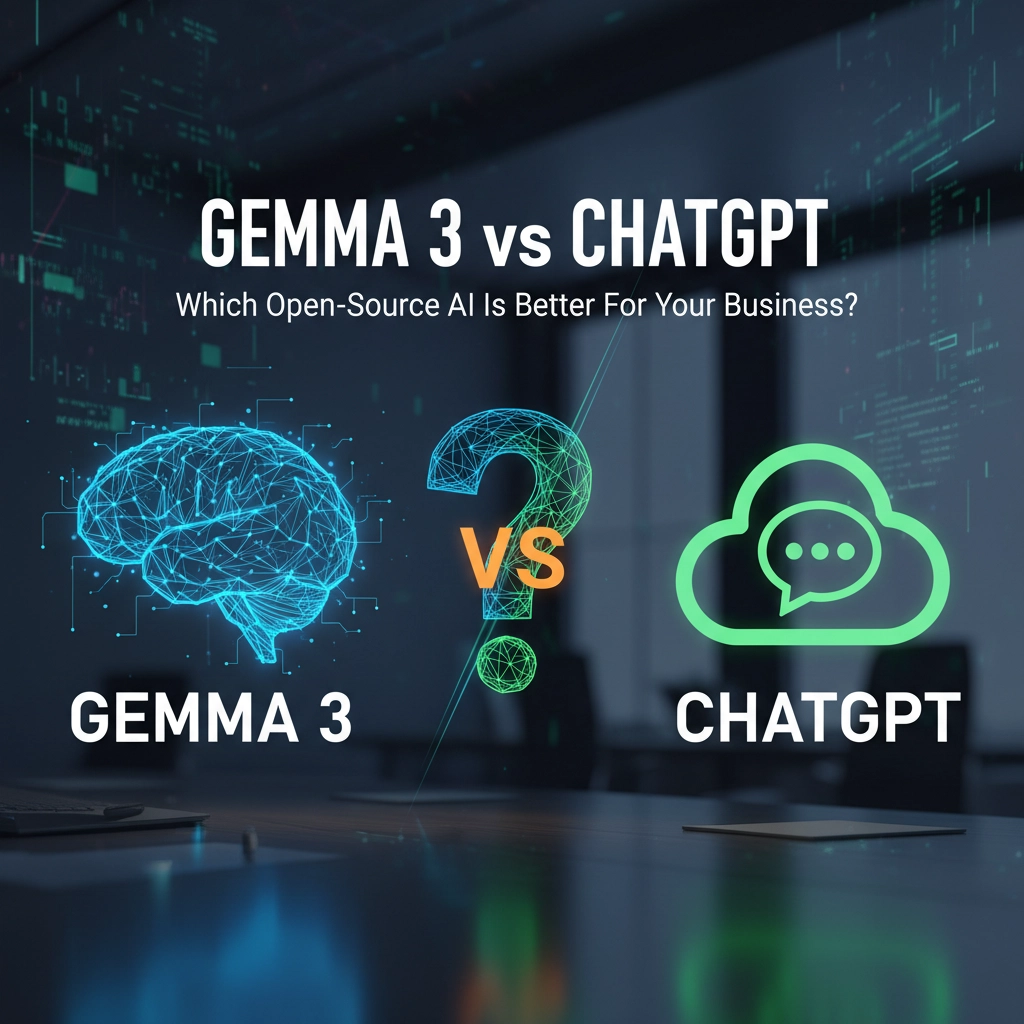
Here's something that might surprise you: one of these AI models isn't actually open-source at all. While everyone's debating which AI tool to pick for their business, they're missing a crucial detail that could save them thousands of dollars (or cost them big time).
Let me tell you about Sarah, a startup founder who spent three months paying premium ChatGPT fees for her content agency. She was processing hundreds of client requests daily, watching her AI costs balloon to over $800 monthly. Then she discovered Gemma 3 and cut her AI expenses by 90% overnight. But here's the twist – her content quality actually got worse in some areas.
What Makes These AI Models Different
The biggest misconception floating around is that both Gemma 3 and ChatGPT are open-source options. That's completely wrong. ChatGPT is OpenAI's proprietary system – you can't peek under the hood, can't run it on your own servers, and you're stuck with their pricing forever.
Gemma 3, on the other hand, is Google's truly open-source model. You can download it from HuggingFace, modify the code, and run it on a single GPU in your basement if you want. This isn't just a technical difference – it's a fundamental business decision that affects everything from your monthly costs to your data privacy.

When you're using ChatGPT, every single conversation goes through OpenAI's servers. Your business data, client information, and proprietary content all flow through their systems. With Gemma 3, you can process everything locally. No cloud dependency, no data leaving your building, no wondering what happens to your sensitive information.
But here's where it gets interesting. Gemma 3 absolutely crushes ChatGPT in reasoning tasks. If your business needs an AI that can work through complex logical problems, analyze data patterns, or make calculated decisions, Gemma 3 consistently outperforms. It's like having a brilliant analyst who never gets tired.
However, if you need an AI that writes like a human, Gemma 3 falls flat. The content feels robotic, lacks personality, and often misses the subtle nuances that make writing engaging. ChatGPT excels here – it's been trained specifically to sound natural and conversational.
Breaking Down the Real Costs
Let's talk money because this is where things get wild. Gemma 3's pricing model will make your accountant smile:
• Input tokens: $0.03 per million tokens
• Output tokens: $0.10 per million tokens
• Context window: 131,072 tokens (slightly more than ChatGPT's 128,000)
• Hidden costs: Zero (after initial setup)
Compare that to ChatGPT's premium pricing structure, and you're looking at potential savings of 80-95% for high-volume users. If you're processing thousands of documents monthly, analyzing customer feedback, or running automated content workflows, Gemma 3 can literally save you tens of thousands annually.

But there's a catch – setup complexity. Getting Gemma 3 running requires technical expertise. You need someone who understands GPU configurations, model deployment, and infrastructure management. ChatGPT works the moment you create an account.
For Sarah's agency, the math worked out perfectly. She was processing about 2 million tokens monthly. With ChatGPT, she was paying around $800. With Gemma 3, her costs dropped to roughly $80 monthly. That $720 difference let her hire another part-time writer.
When Gemma 3 Actually Wins
There are specific scenarios where Gemma 3 isn't just competitive – it's clearly superior. Data-sensitive industries love it because everything stays on-premises. Financial firms, healthcare companies, and legal practices can use AI without worrying about compliance nightmares.
Manufacturing companies use Gemma 3 for quality control analysis. The model excels at pattern recognition and can spot defects or anomalies that humans might miss. One automotive parts manufacturer I spoke with reduced their inspection costs by 40% using locally-deployed Gemma 3 models.
Research organizations particularly benefit from Gemma 3's reasoning capabilities. It can work through complex scientific problems, analyze experimental data, and even help design new research methodologies. The open-source nature means researchers can modify the model for their specific needs.

If you're building AI-powered products, Gemma 3 offers something ChatGPT never can – complete customization. You can retrain it on your specific data, adjust its behavior patterns, and integrate it seamlessly into your existing systems without API limitations or rate restrictions.
Why Most Businesses Still Choose ChatGPT
Despite Gemma 3's advantages, ChatGPT remains the go-to choice for most businesses. The reason is simple – it just works better for typical business tasks.
Content creation is where ChatGPT shines brightest. Marketing teams, social media managers, and copywriters consistently prefer ChatGPT because it produces more engaging, human-like content. The difference isn't subtle – it's obvious from the first sentence.
ChatGPT's coding capabilities are also significantly stronger. If your business needs AI assistance with programming, debugging, or technical documentation, ChatGPT consistently outperforms. It understands context better, provides more practical solutions, and explains complex concepts clearly.
The AI agent functionality sets ChatGPT apart too. You can set up automated workflows that handle customer service, generate reports, or manage routine tasks without constant supervision. Gemma 3's agent capabilities are still developing and nowhere near ChatGPT's sophistication.

Speed matters in business, and ChatGPT typically responds faster than Gemma 3, especially for real-time applications. If you're building customer-facing tools or need immediate responses, the performance difference is noticeable.
Integration is another huge factor. ChatGPT works seamlessly with hundreds of business tools – CRM systems, marketing platforms, productivity apps. Gemma 3 requires custom development work for most integrations.
Remember Sarah's story? After switching to Gemma 3, she had to hire additional editors because the content quality dropped. Her clients started complaining about robotic-sounding copy. Eventually, she found a hybrid approach – using Gemma 3 for data analysis and research, while keeping ChatGPT for client-facing content.
The truth is, there's no universal winner. Your choice depends entirely on your specific needs, technical capabilities, and budget constraints. If you're processing massive volumes of data, need complete control over your AI infrastructure, and have the technical team to manage deployment, Gemma 3 offers compelling advantages.
But if you need high-quality content, sophisticated automation, or want something that works perfectly right out of the box, ChatGPT remains the stronger choice despite the higher costs.
What's your biggest AI challenge right now – cutting costs or improving output quality?