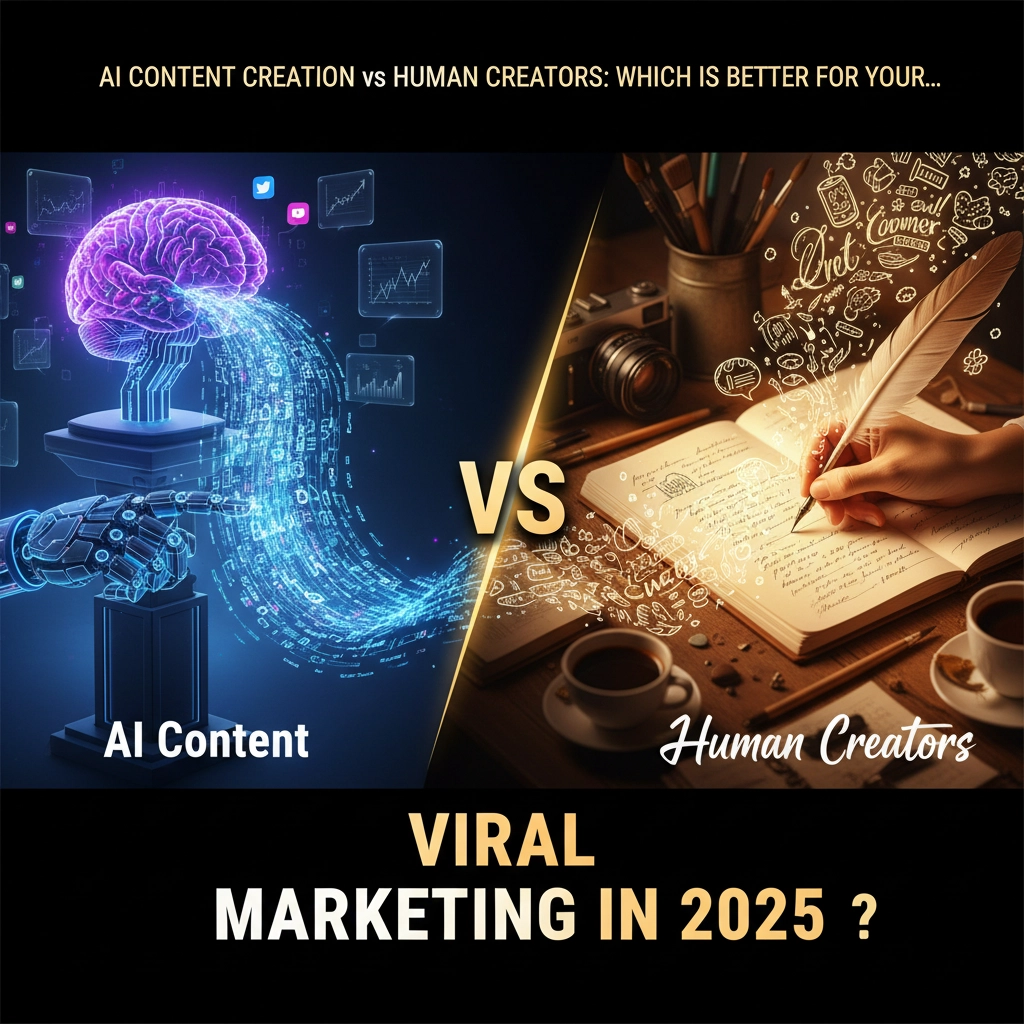
Here's a stat that'll blow your mind: content creators using AI tools are hitting engagement rates up to 6 times higher than traditional brand messaging. But before you fire your creative team and go full robot, there's another number you need to know – only 26% of consumers actually prefer AI-generated content over human-created stuff.
Welcome to the wild world of 2025 viral marketing, where the biggest question isn't whether to choose AI or humans. It's how to blend them without losing your soul (or your audience).
Why This Battle Matters in 2025
The content game has completely flipped. We're not just competing for attention anymore – we're fighting algorithms, shortened attention spans, and audiences who can spot fake authenticity from a mile away.
Think about it: your audience scrolls past 1,000+ pieces of content daily. What makes them stop? What makes them share? The answer isn't as simple as "make it pretty" or "use trending hashtags."
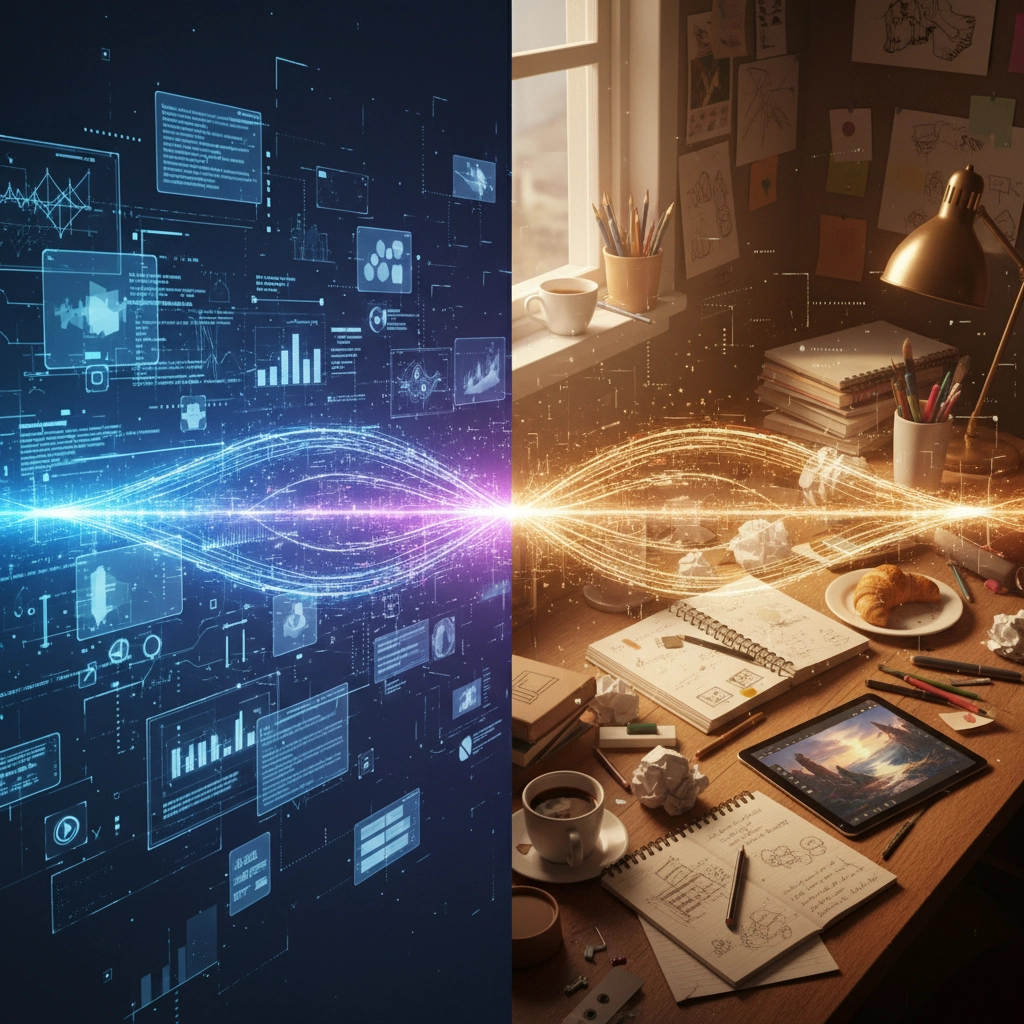
The data tells a fascinating story. While 93% of marketers are now using AI to pump out content faster, the most successful viral campaigns still have one thing in common – they feel genuinely human. But here's the twist: the creators behind these human-feeling posts? They're often using AI behind the scenes.
AI Content Creation – The Speed Demon
Let's talk about what AI absolutely crushes at. Speed isn't even the word – it's more like content teleportation. Where a human might spend 2 hours crafting the perfect Instagram caption, AI can generate 50 variations in under 5 minutes.
But AI's real superpower isn't just speed. It's pattern recognition on steroids. AI tools can analyze millions of viral posts, identify what made them tick, and reverse-engineer the psychological triggers that make people hit "share."
Take trending hashtags, for example. While you're still figuring out if #MondayMotivation is played out, AI has already analyzed engagement data from the last 48 hours and knows that #MindfulMonday is climbing fast in your target demographic.

AI also dominates at personalization. It can take one piece of content and automatically adapt the tone, language, and even visual elements for different audience segments. Your Gen Z audience gets quick, punchy copy with trendy slang. Your millennial crowd gets more detailed, nostalgic references. All generated from the same source material.
The downside? AI content often feels… safe. Polished but predictable. It follows patterns so closely that it rarely breaks new ground. And audiences in 2025 are getting scary good at detecting that "AI smell" – you know, that slightly-too-perfect, slightly-too-generic feeling.
Human Creators – The Soul Factor
Now let's flip the script. What do humans bring that AI can't fake? Raw, messy, beautiful authenticity.
Humans don't just create content – they live it. When a creator shares their 3 AM anxiety about launching a business, or posts a behind-the-scenes video of their epic cooking fail, that's not content strategy. That's life happening in real-time. And audiences connect with life.
Here's where it gets interesting: human creators excel at cultural timing. They don't just see trends – they feel the cultural moment. They know when to jump on a meme and when to stay away. They understand nuance, context, and the unspoken rules of different communities.

Take humor, for example. AI can analyze what made jokes go viral last month, but comedy often works precisely because it breaks expectations. Human creators can read the room, take risks, and create those lightning-in-a-bottle moments that become legendary memes.
But humans have a massive limitation: bandwidth. Creating quality content consistently across multiple platforms while staying authentically engaged with audiences? It's exhausting. Many creators burn out trying to keep up with AI-powered competitors who seem to post 24/7.
The Winning Formula: AI + Human = Viral Gold
Here's what the most successful viral marketers figured out: you don't choose sides. You create a content assembly line where AI handles the heavy lifting and humans add the magic.
The process looks something like this:
- AI does the research – analyzing trending topics, optimal posting times, and high-performing content formats
- Humans create the concept – the emotional hook, the unique angle, the authentic voice
- AI generates variations – multiple versions of captions, headlines, and visual elements
- Humans refine and approve – adding personality, fixing tone, ensuring it feels authentic
- AI handles optimization – A/B testing, performance tracking, and real-time adjustments
This hybrid approach is crushing it. One sustainable fashion brand used this exact method to create a TikTok video that hit 2.5 million views. AI identified that "quick transformation" content was trending, humans crafted an authentic story about ditching fast fashion, AI generated multiple versions of the script, and humans added the personal touches that made it shareable.
The key insight? AI amplifies human creativity rather than replacing it. It's like having a super-powered research assistant, content factory, and optimization engine all rolled into one – but the creative soul still comes from humans.
Here are the specific ways to make this hybrid approach work:
• Use AI for ideation sprints – generate 20 content ideas in 5 minutes, then pick the ones that spark your human intuition
• Let AI handle the boring stuff – hashtag research, optimal posting times, competitor analysis
• Keep humans in charge of brand voice – AI can mimic your tone, but humans define what that tone should be
• Use AI for rapid testing – create multiple ad variations quickly, but let humans interpret what the results actually mean
• Reserve cultural moments for humans – trending topics, breaking news, and sensitive subjects need human judgment
• Automate optimization, not creativity – use AI to improve performance of content that humans created
The Creator Who Cracked the Code
Let me tell you about Sarah, a fitness creator who went from 10K to 2 million followers in 8 months using this exact hybrid approach. She was burning out trying to post daily workouts, meal prep tips, and motivational content across four platforms.
Instead of giving up, she got smart. Sarah used AI to analyze her top-performing posts and discovered that her audience loved "real talk" moments more than perfect workout videos. So she doubled down on authenticity – but used AI to handle everything else.
AI helped her identify the best times to post, generated workout variations based on her signature style, and even created multiple versions of her captions. But Sarah kept control of the personal stories, the vulnerable moments, and the unique perspective that made her content genuinely helpful.
The result? Her engagement rates doubled while her content creation time got cut in half. More importantly, her audience kept growing because the content still felt unmistakably like Sarah – just more consistent and optimized.
What's your take? Are you team AI, team human, or ready to create your own hybrid content machine?