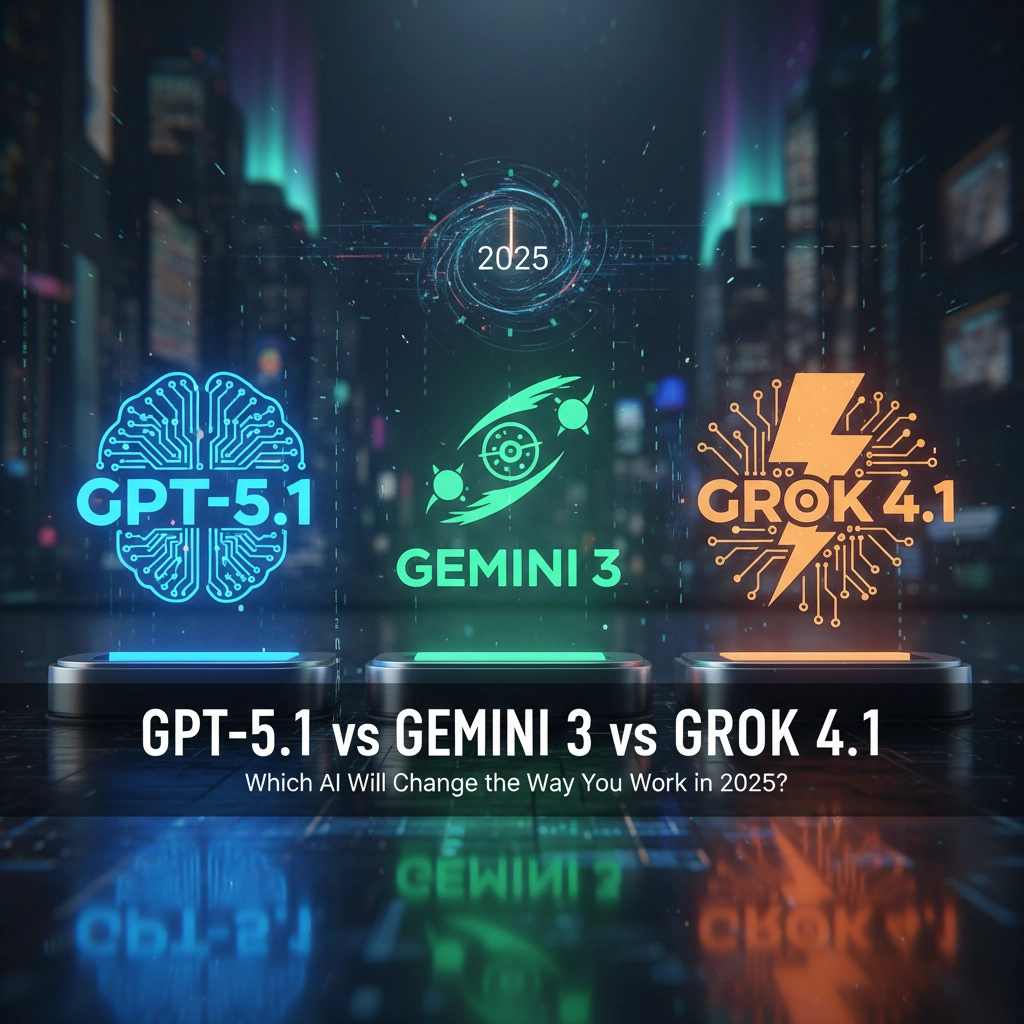
Three new AI models just dropped, and they're about to shake up how you work every single day. GPT-5.1 launched on November 13th, Gemini 3 quietly rolled out through Google's mobile app, and Grok 4.1 is making waves with real-time data access. But here's the thing: each one solves completely different problems.
If you're wondering which AI will actually change your workflow (not just impress you with demo videos), you're asking the right question. Let's break down what each model actually does best, and more importantly, which one fits your daily grind.
GPT-5.1: The Speed Demon That Gets Stuff Done
OpenAI's latest model isn't trying to win every benchmark: it's trying to win your workday. GPT-5.1 comes in two flavors: Instant and Thinking. The Instant version gives you answers in 2.3 seconds flat, while Thinking mode kicks in when you need deeper reasoning.

What makes GPT-5.1 different? It's smart enough to know when not to overthink. Ask it to write a quick email, and it won't waste 30 seconds "reasoning" about the perfect word choice. Ask it to solve a complex coding problem, and it'll switch to deeper analysis mode.
The coding performance is where GPT-5.1 really shines. It hits 76% on SWE-Bench Verified, which basically means it can handle three out of four real-world programming challenges you throw at it. Plus, it's about 60% cheaper than Claude for similar tasks.
Here's what developers love about GPT-5.1:
- Lightning-fast responses for everyday coding tasks
- Doesn't get stuck in analysis paralysis on simple questions
- Works seamlessly with existing tools and APIs
- Reliable enough for production workflows
- Cost-effective for teams processing lots of requests
The downside? It's not the visual wizard that Gemini 3 is, and OpenAI still hasn't released official pricing details (which is honestly pretty annoying if you're trying to budget for it).
Gemini 3: The Reasoning Beast That Solves Hard Problems
Google took a different approach with Gemini 3. Instead of optimizing for speed, they went all-in on reasoning power. The results are honestly impressive: and a little scary.
Gemini 3 scored 45.1% on ARC-AGI-2 when using its "Deep Think" mode. That might not sound like much, but consider this: GPT-5.1 only manages around 15-20% on the same test. ARC-AGI-2 measures how well AI can solve completely novel problems it's never seen before: the kind of abstract thinking that separates humans from pattern-matching machines.

But here's where Gemini 3 gets really interesting for daily work: it's become the go-to choice for visual and design tasks. One content creator I know switched their entire workflow to Gemini 3 and cut their production time by 40%. They're now generating HTML/CSS with working animations, iterating on designs in real-time, and exporting production-ready files in under 20 minutes.
The math performance is also bonkers: 95% on AIME (American Invitational Mathematics Examination) without any external tools. For context, that's a competition where the average human score hovers around 1-2 out of 15 problems.
Sarah, a UX designer in Seattle, told me she was skeptical about AI design tools until she tried Gemini 3. "I asked it to create a dashboard mockup with specific accessibility features," she said. "Not only did it nail the visual design, but it actually suggested improvements to my color contrast ratios that I hadn't thought of. It's like having a senior designer who never gets tired."
Grok 4.1: The Real-Time Information Machine
While GPT-5.1 and Gemini 3 are great at processing what they already know, Grok 4.1 is built for what's happening right now. It has native access to real-time data, massive context windows, and it's designed to work as an autonomous agent that can search, analyze, and act.

The pricing is where Grok 4.1 really stands out. At $0.20 for input and $0.50 for output per million tokens, it's significantly cheaper than competitors for high-volume tasks. If you're processing long documents or need to analyze massive amounts of text, the cost savings add up fast.
Grok 4.1 excels in areas where the other models stumble:
- Understanding current events and trending topics
- Social media sentiment analysis
- Processing extremely long documents or conversations
- Emotional intelligence and audience engagement insights
- Agent-style workflows that require multiple steps
The trade-off? Pure reasoning performance lags behind Gemini 3, and it's not optimized for visual content generation like design work or image creation.
Which AI Should You Actually Use?
Here's the reality: the "best" AI depends entirely on what you're trying to accomplish.
For software developers: GPT-5.1 is your daily driver. The 2.3-second response time and strong coding performance make it perfect for the constant back-and-forth of development work. Use Gemini 3 only when you're stuck on complex architectural decisions.
For researchers and analysts: Gemini 3's reasoning capabilities are unmatched. If you're working on problems that require genuine insight rather than just information retrieval, the 45% ARC-AGI-2 score isn't just a number: it's the difference between getting a useful answer and getting generic text.
For content creators and marketers: This is where it gets interesting. Gemini 3 handles visual design and complex creative work, while Grok 4.1 gives you real-time trend analysis and audience insights. Many creators are running both and routing tasks based on what they need.
For cost-conscious teams: Grok 4.1's pricing structure makes it the clear winner for high-volume text processing. If you're analyzing customer feedback, processing documents, or doing bulk content work, the cost difference is substantial.
The smartest approach? Don't pick just one. The most productive teams are building workflows that route different types of tasks to different models. Gemini 3 for reasoning and design, GPT-5.1 for coding and general text, Grok 4.1 for real-time analysis and high-volume processing.

This isn't about finding the "winner": it's about understanding that we've moved beyond the era of one-size-fits-all AI. Each model has carved out distinct strengths, and the teams that figure out how to leverage all three will have a massive advantage over those trying to force one model to do everything.
The question isn't which AI will change how you work in 2025: it's whether you'll adapt your workflow to use the right tool for each job, or stick with whatever you tried first?