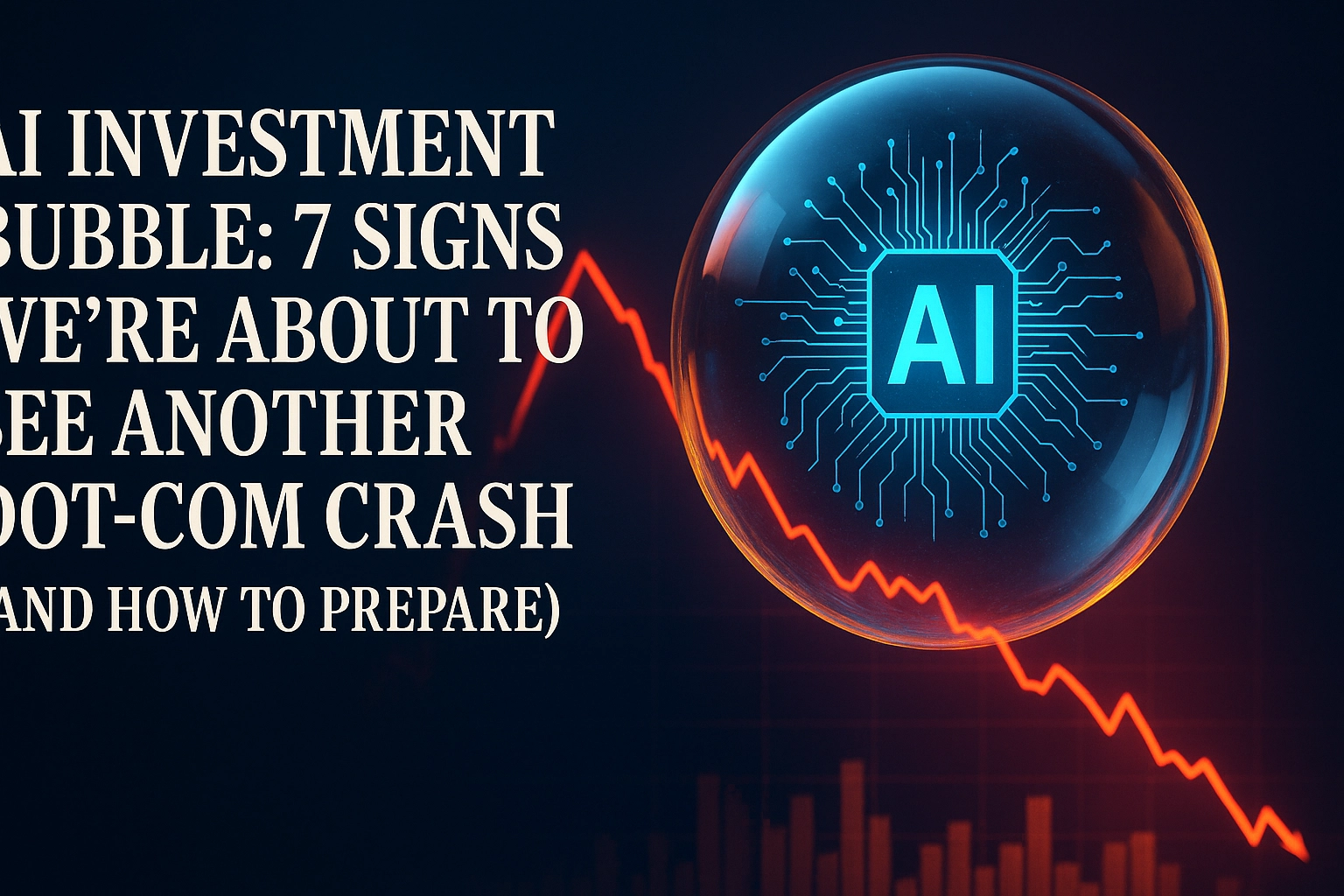
Remember when everyone thought pets.com was the future of retail? Yeah, that didn't age well. Fast forward 25 years, and we're watching history repeat itself, except this time, it's AI companies burning through cash faster than a Tesla on Ludicrous Mode.
The warning signs are everywhere, but most investors are too busy counting their Nvidia gains to notice. Here's what the smart money is seeing that you're not.
The Numbers Don't Lie: We're in Bubble Territory
Let's cut through the hype and look at some cold, hard facts. In late 2025, just five companies now control 30% of the entire S&P 500. That's the highest concentration we've seen in half a century.
When DeepSeek launched in January 2025, Nvidia dropped 17% in a single day. That's not normal market behavior, that's panic selling from investors who suddenly realized their golden goose might be made of fool's gold.

Sign #1: Market Concentration Has Reached Dangerous Levels
Here's something that should keep you awake at night: 30% of the S&P 500 and 20% of the MSCI World index is now held by just five companies. We haven't seen this level of concentration since the 1970s.
What does this mean? If these AI giants stumble, the entire market goes down with them. It's like building a house of cards in a windstorm, eventually, physics wins.
Sign #2: Valuations Are Completely Divorced from Reality
The S&P 500 is trading at 23 times forward earnings. Compare that to the FTSE at 14 times, and you can see we're in fantasyland. These are the most stretched valuations we've seen since the dot-com bubble burst.
Companies are being valued based on AI promises, not actual profits. Sound familiar?
Sign #3: The Return on Investment Is Basically Zero
Here's the kicker: An MIT study from August 2025 found that despite $30-40 billion in enterprise AI investment, 95% of organizations are getting zero return.
Zero. Nada. Zilch.
That's not a sustainable business model, that's a very expensive hobby.

Sign #4: Spending Has Gone Completely Insane
AI companies are spending about $500 billion on infrastructure and another $250 billion on research. Meanwhile, their revenue? Well, let's just say the math doesn't add up.
It's like watching someone buy a Ferrari with a credit card while working minimum wage. Eventually, the bills come due.
Sign #5: Everyone's Investing in Everyone Else
The AI space has become an echo chamber where the same players, OpenAI, Nvidia, Microsoft, Google, keep investing in each other. It's circular financing at its finest.
When everyone's betting on the same horse, what happens when that horse stumbles?
Sign #6: One Sector Is Carrying the Entire Market
Get this: AI-related companies accounted for roughly 80% of all stock market gains in 2025. That's not diversification, that's putting all your eggs in one very fragile basket.
Sign #7: Even the Insiders Are Warning Us
When the people making money from the AI boom start sounding alarm bells, you should listen:
- Sam Altman (OpenAI CEO): "People will overinvest and lose money"
- Jeff Bezos: Called it "kind of an industrial bubble"
- Jamie Dimon (JP Morgan): Warned of a "higher chance of meaningful stock drop"
- Goldman Sachs CEO: "A lot of capital was deployed that doesn't deliver returns"
These aren't random bloggers, these are the people who should be the biggest AI cheerleaders.

But Wait, Is This Time Really Different?
Here's where it gets interesting. Unlike the dot-com crash, today's AI spending is mostly funded by actual profits from established tech giants, not venture capital funny money. These companies have real balance sheets and genuine demand for their products.
The dot-com crash was fueled by Y2K panic, fraudulent spending, and companies with zero revenue going public. That's not exactly what we're seeing today.
How to Prepare for What's Coming
The smart money isn't running for the hills, it's getting selective. Here's what you should be doing:
Focus on companies with real cash flow and actual customers. Not just promises and PowerPoint presentations.
Diversify away from the big five. If 30% of the market is concentrated in five companies, maybe don't put all your money there.
Watch the 2026-2027 window. Multiple analysts are pointing to this timeframe for when reality meets expectations. That's when the gap between spending and revenue becomes impossible to ignore.
Look for companies solving real problems with AI, not just using it as a buzzword. There's a difference between "AI-powered" and "AI-dependent."
The Personal Reality Check
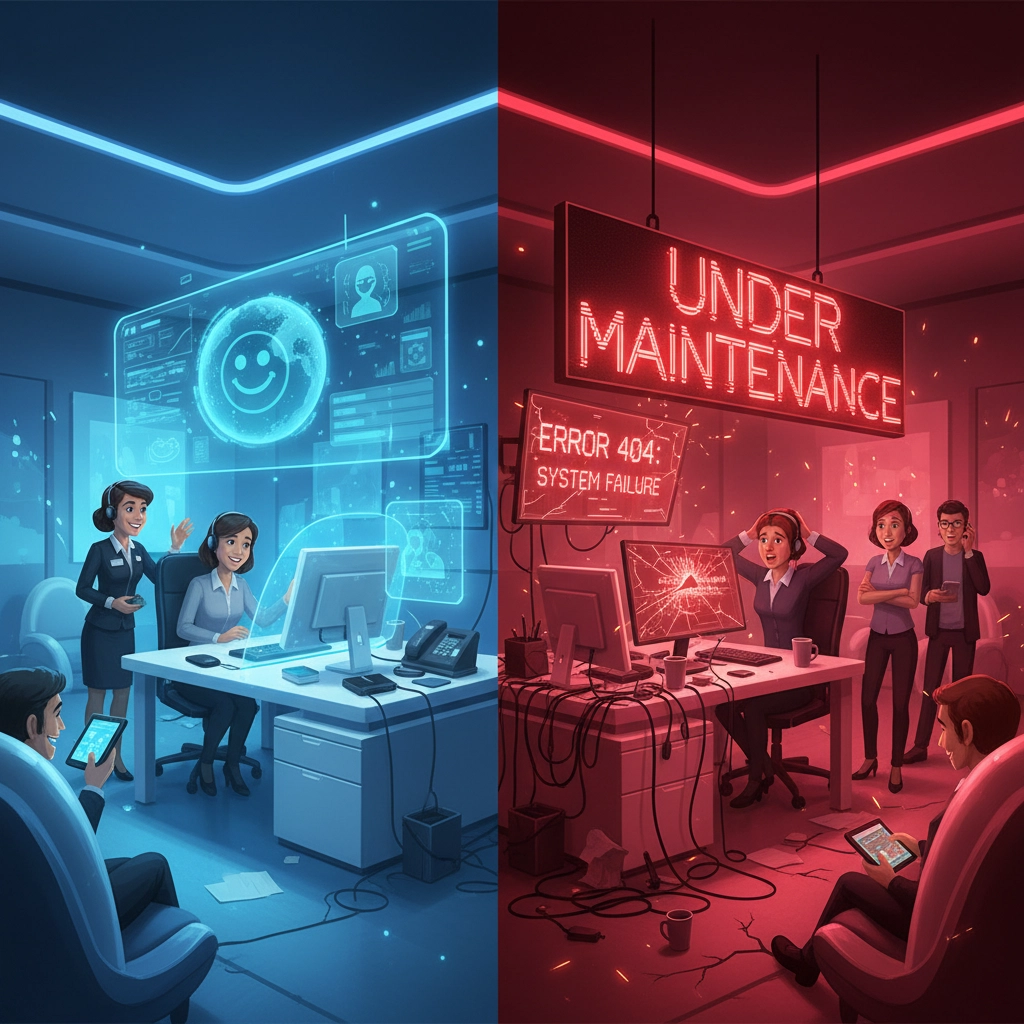
I have a friend who works at a Fortune 500 company. Last month, they spent $2 million on an AI system that was supposed to revolutionize their customer service. Three months later, they're still training it to understand basic questions, and customer satisfaction has actually gone down.
That's not an isolated story. That's the reality behind the hype.
What Happens When the Music Stops?
The thing about bubbles is that they feel amazing while you're in them. Everyone's making money, everyone's a genius, and this time really does feel different.
Until it doesn't.
The AI revolution is real. The technology is transformative. But that doesn't mean every company slapping "AI" on their business plan deserves a billion-dollar valuation.
When the correction comes, and history suggests it will, the companies with real products, real customers, and real cash flow will survive. The rest? Well, ask pets.com how that worked out.
The question isn't whether there will be a correction. The question is whether you'll be prepared when it happens.
So here's what I'm wondering: Are you betting on AI because you believe in the technology, or because everyone else is doing it? Because in a bubble, those are two very different things.