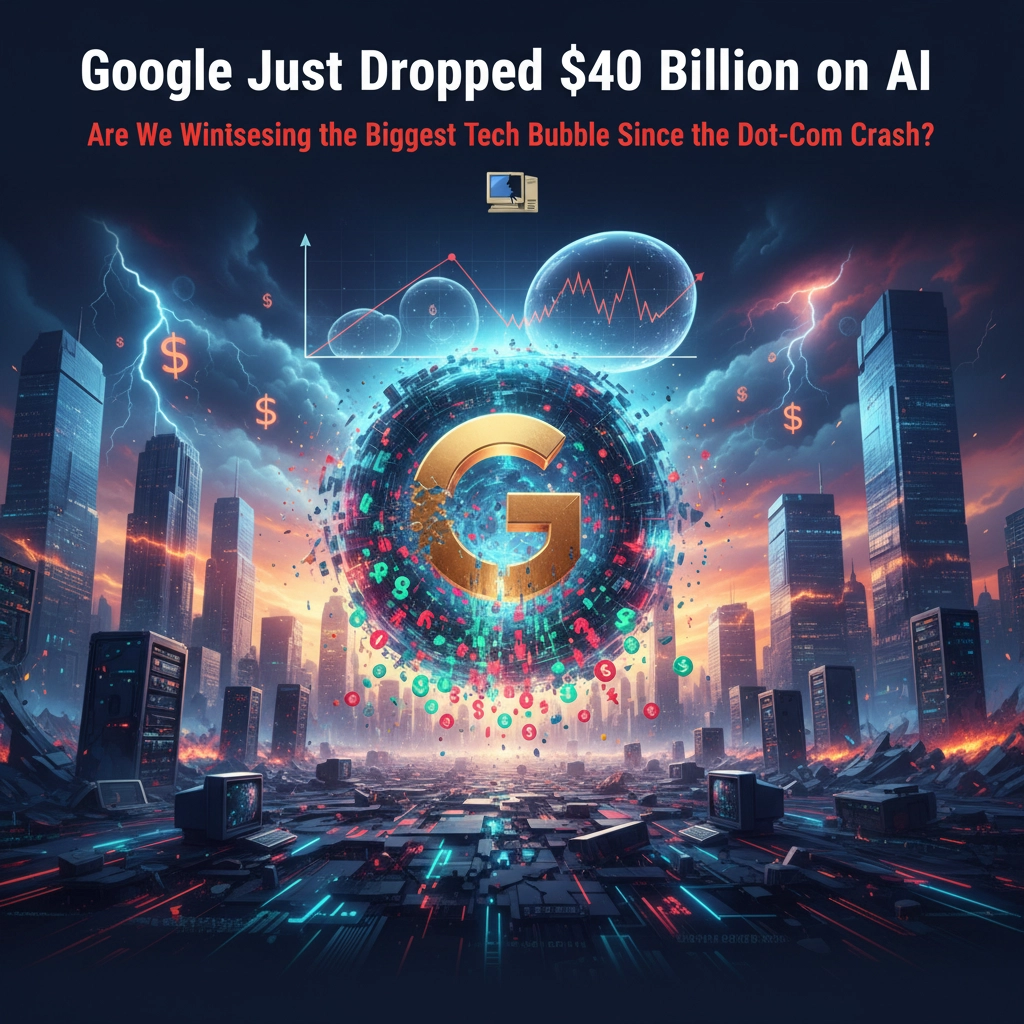
Remember when everyone thought pets.com was the future? Well, Google just bet $40 billion that AI won't end up the same way. But here's the thing – some very smart people think we're heading for another spectacular crash.
On November 14, 2025, Google announced they're dropping a mind-boggling $40 billion in Texas over the next two years. Not on fancy offices or corporate retreats. On AI infrastructure. The kind of massive data centers that'll power whatever comes after ChatGPT.
But is this visionary investing or are we watching the setup for tech bubble 2.0?
What Google Actually Did With That $40 Billion

Google isn't just throwing money around randomly. They're building two massive data center campuses in Armstrong and Haskell Counties, Texas. These aren't your typical server farms – we're talking about AI powerhouses designed to handle the next generation of artificial intelligence.
Here's what that $40 billion actually gets you:
• State-of-the-art cloud computing infrastructure
• Advanced AI training facilities
• Workforce development programs (training over 1,700 apprentices by 2030)
• Enough computing power to "ensure the U.S. retains the technical backbone to lead the world in AI"
The timing isn't coincidental either. Google's racing against Microsoft, Amazon, and others to build the infrastructure that'll power AI for the next decade. Think of it like the gold rush – except instead of mining picks and shovels, they're selling computing power.
But here's where it gets interesting. Unlike the dot-com days when companies burned cash with no clear revenue model, Google's already making serious money from their existing data centers. Their cloud revenue grew about 30% last year, with increasing profit margins.
The Bubble Warning Signs Are Real

Let's not sugarcoat this – there are some seriously concerning signs that we might be in bubble territory.
MIT researchers found that 95% of companies investing in generative AI are seeing zero measurable returns. That's not just disappointing – it's terrifying when you consider how much money is flowing into AI right now.
Apollo Global Management's chief economist dropped this bomb: current AI valuations have already exceeded dot-com bubble peaks. When adjusted for inflation, we're spending more on AI infrastructure than the entire dot-com boom cost.
Even OpenAI's CEO Sam Altman and billionaire investor Ray Dalio are sounding alarm bells. Dalio put it perfectly: investors are "confusing AI being a great technology with it being a great investment."
Remember my friend Jake from college? Smart guy, got his MBA from Wharton. Last month he told me he'd invested his entire 401k in AI startups because "this time is different." That phrase should send chills down anyone's spine who lived through 2000.
The University of Michigan's Eric Gordon thinks investors could get hurt even worse than they did during the dot-com crash. The scale is just so much bigger this time.
But This Isn't Your 2000s Dot-Com Crash

Here's where the Google investment starts looking less crazy. The dot-com bubble was built on companies with no revenue burning through venture capital. But Google? They're already printing money from their existing infrastructure.
The key difference is this: Google, Amazon, and Microsoft aren't speculative AI startups. They're infrastructure companies that make real money from real customers who pay real bills every month.
Dan Ives from Wedbush Securities calls this a "4th industrial revolution" rather than a bubble. His point makes sense – when the mobile internet boom happened, the companies that built the infrastructure (cell towers, data centers) made fortunes while app developers came and went.
Google's Texas investment looks a lot more like building essential infrastructure than speculative betting. These data centers will serve paying customers regardless of whether the latest AI chatbot succeeds or fails.
The numbers back this up too. While 95% of AI companies might not be seeing returns, the infrastructure providers are reporting consistent 30% growth with expanding profit margins. That's the opposite of bubble behavior.
What This Means for Everyone

So what should regular people make of Google's massive bet?
First, it's probably not the start of dot-com crash 2.0. The infrastructure companies know what they're doing and have paying customers. But that doesn't mean every AI company is a good investment.
The real risk isn't in companies like Google building data centers. It's in the thousands of AI startups with no clear path to profitability getting funded at insane valuations. Those are your pets.com equivalents.
For consumers, Google's investment is actually good news. More AI infrastructure means better, faster, and potentially cheaper AI services. Competition between Google, Microsoft, and Amazon will likely drive innovation and lower costs.
For investors, the lesson is simple: infrastructure providers with real revenue are probably safe bets. AI apps and services? Much riskier territory.
The timing also matters. We're still in the early days of practical AI applications. Unlike 2000 when the internet was already mainstream, AI is just starting to show up in everyday products and services.
Google's $40 billion isn't a sign of irrational exuberance – it's a calculated bet on building the roads that AI traffic will travel on for the next decade.
The real question isn't whether Google made a smart investment. They probably did. The question is whether the hundreds of AI startups getting funded at crazy valuations will survive when the music stops.
What do you think – are we building the future or setting up for another spectacular crash?